
How to Search Criminal Dockets
The North Carolina eCourts Portal is the first public route into a Chowan criminal docket. Smart Search takes a Record Number or a name. Location, case-type, status, and date filters narrow things down. Pick Chowan County before you trust a result as local. The Portal calls its docket-style record a Case Summary, also known as a Register of Actions, and it may display public Chowan case, assignment, party, event, disposition, hearing, and financial information where applicable.
Have a citation, notice, or court paper? Use its exact number. A careful name search fills the gap when you lack one. The Portal training materials walk through the public tools and their limits. Treat any result as a starting point, not a certified Chowan record.
- Open Smart Search and enter the exact record number, or the minimum name information needed.
- Select Chowan County in advanced filters. Add a type, status, or date only when it is known.
- Open the matching Case Summary instead of relying only on the result row.
- Read public events and dispositions, then use Search Hearings for a future-date check.
- Contact the clerk or use a public terminal for an official copy, certification, or access question.
Chowan Criminal Docket Smart Search
Smart Search runs statewide, so the Chowan location filter does the real work. A Record Number is the narrowest route in. With a name search, check results against the Chowan case type and other public details. Go easy on extra filters. They can screen out the Chowan result you want, and the system caps the list at 200 results. Search public Chowan case information in the Portal itself. Enterprise Justice File & Serve is not the public search route but the authorized electronic filing system.
| Field | Use for a Chowan criminal docket |
|---|---|
| Record Number or Name | Use the exact Chowan number when known, or a careful name search. |
| Location | Select Chowan County to focus the statewide result set. |
| Case Type | Add it only when the Chowan criminal classification is known. |
| Status or date | Use as a filter, then read the Case Summary for context. |
Chowan Criminal Docket Status Terms
Status labels sort a Chowan criminal docket. But they do not decide what an entry means. Read each label beside the public Chowan events and disposition information. Pending, Disposed, Completed, Appealed-Appellate, Pending Expungement, Remanded, Transferred Superior, and Transfer Another County can all appear as search labels. A Chowan setting can move. Status itself can shift after your lookup.
- CR
- A case with at least one criminal offense.
- IF
- A case consisting only of infractions.
- Pending
- A navigation status, not a prediction of outcome.
- Disposed
- A status best read with the recorded disposition.
- Hearing
- A scheduled court event that can be continued or changed.
A statewide number opens with a two-digit year, then case-type letters, a six-digit sequence, a hyphen, and a three-digit county code. Copy the real Chowan number exactly. Never build an example yourself.
What a Criminal Docket Shows
A Chowan criminal Case Summary is the public-facing Register of Actions. It does not promise that every Chowan field or filing shows up. What appears depends on the matter and on access controls. Read the field names alongside the public event history, not as isolated labels.
| Case number | The exact statewide identifier from a citation, notice, filing, or clerk record. |
|---|---|
| Case information | Public Chowan details and parties shown for that matter. |
| Assignment | Public assignment information where the Case Summary makes it available. |
| Case events | Public Chowan entries that place filings and settings in order. |
| Disposition and hearings | Recorded outcome and setting information where applicable. |
| Financial information | Data shown where applicable and publicly available. |
Once you know the case, try Search Hearings for a focused Chowan current-date check. A public calendar entry can still be continued, transferred, or corrected.
Chowan Criminal Docket eCourts Change
Chowan joined eCourts in February 2024. The Judicial Branch launch announcement explains the change. It is why the Portal is now the normal first stop for current Chowan criminal research. Electronic case management did not replace the clerk, though. The Chowan clerk still handles local inspection, copies, and certification. It also resolves anything an online display does not.
Older or hard-to-find Chowan material may still need a clerk inquiry. The Portal locates public Chowan information. File & Serve handles authorized filings. The Chowan clerk keeps the local court-record functions. Write down your lookup date whenever a hearing or disposition matters, because public Chowan docket information can change.
Stages on a Criminal Docket
A Chowan criminal docket tracks court activity, not a fixed timetable. A case may start with a citation, allegation, or charging process. Misdemeanors and infractions usually open in District Court. Felonies go to Superior Court. As the matter moves through the Chowan trial-court process, the Case Summary lines up public event entries and hearing information in sequence.
Docket flow: Filing → Arraignment → Pretrial → Plea or Trial → Disposition → Sentencing
Treat the Chowan flow as an orientation tool. It promises neither that every event appears in every Chowan case nor that a case moves without a continuance. A disposition simply records the resolution or outcome of a charge or case event.
Chowan Criminal Docket Court Levels
Chowan County runs on North Carolina's unified trial-court system. Misdemeanors, infractions, and most traffic cases start in District Court. Felonies belong to North Carolina Superior Court, Chowan County. A single Clerk of Superior Court office keeps the docket for both levels. The two courts split the work. Even so, a Chowan County court docket search stays simple.
For more detail on how these levels divide a Chowan criminal docket, the official District Court overview lays out the structure.
Knowing whether a matter is a misdemeanor, infraction, or felony explains where Chowan criminal docket activity begins. It still does not replace the exact case number or the current Case Summary.
Chowan Criminal Docket Terminal Route
The Portal is not the only access channel. Per the court-records guidance, public terminals at a clerk office in any county support criminal searches by defendant name, case number, or victim or witness. A statewide Portal result may identify a Chowan matter. A county-held paper file or certified copy still requires the clerk.
| Need | Chowan criminal docket route |
|---|---|
| Public current case view | Portal Smart Search with Chowan County selected. |
| In-person lookup | Use a Chowan public terminal, then ask the Chowan clerk about the local file. |
| Plain or certified copy | Ask the Clerk of Superior Court for the case-specific route and access rule. |
| Transcript | Contact the official court reporter for the Chowan matter, not the clerk. |
The Chowan courthouse sits at 101 S. Broad St., Edenton, NC 27932. Chowan public hours run Monday through Friday, 9:00 a.m. to 5:00 p.m. For criminal matters, call the division at (252) 368-5002, or reach the main clerk office at (252) 368-5000.
Which Court Holds Criminal Dockets
Felony trials in Chowan County belong to North Carolina Superior Court. District Court handles most misdemeanors and infractions first. That split decides where a case gets heard, yet it does not create separate local clerks. Under G.S. 7A-109, the Clerk of Superior Court keeps the court records, files, dockets, indexes, and judgments, subject to access restrictions. Dwayne Goodwin serves as Clerk of Superior Court, Chowan County, per the Judicial Branch directory. The title matters. Officeholders change over time. Keep that in mind before relying on any name. Also note that a Chowan District Court misdemeanor conviction may be appealed for a new trial in Superior Court.
Chowan Criminal Docket No-Result Steps
An empty Chowan Portal screen proves nothing. It is not a finding that no court record exists. The format may be wrong. The matter may sit outside that system, or the information may be restricted. Small errors cause big misses. A spelling difference, a wrong Chowan County filter, or an uncertain Chowan status filter can block a useful match. So can a copied case number with a format error.
Practical next step. Remove uncertain filters, confirm Chowan is the correct location, and ask the Clerk of Superior Court which lawful access route applies if the case still does not appear.
Chowan public terminals and the clerk widen access. They do not erase restrictions. Juvenile files, confidential material, protective-order information, sealed records, and expunged matters can be limited by law or court order.
Public Access and Sealed Criminal Dockets
North Carolina law makes the Chowan clerk the record custodian while preserving exceptions. Public inspection and copies have a limit. They exist only as far as a Chowan record is not confidential by law, rule, or order. A Case Summary result does not open every filing to view. Statuses like Pending Expungement or Transferred Superior can help you locate activity. They do not decide what a person may see.
Key North Carolina rules:
G.S. 7A-109 directs the clerk to keep court records and permits inspection during regular office hours unless an exception applies.
G.S. 132-6 provides for inspection of public records at reasonable times and copies after payment of lawful fees.
G.S. 132-6.1 addresses public government databases while preserving lawful record restrictions.
Counsel with statutory access use the AOC-A-264 elevated-access form. It is not a public route to juvenile, confidential special-proceeding, or protective-order material.
Chowan Criminal Docket Expunction Limits
Expunction is the lawful way to clear a Chowan County criminal record, and the North Carolina expunction resource walks through it. You file the petition with the clerk in the county where the charge or conviction happened, which for local cases means the Chowan Clerk of Superior Court. An order can remove, seal, or destroy the record. Not every case qualifies; eligibility turns on the statute. The standard fee is $175. Some dismissal and not-guilty situations are excepted, and the process can take months.
The official expunction resource is a good reminder that a Chowan criminal docket has lawful limits on what it will show.
A granted destruction order can change what Chowan later provides. Ask the clerk what Chowan expunction record, if any, remains available rather than hunting a restricted matter through another public database.
Chowan Criminal Docket Copy Routes
Need a filed document or certified copy? Contact the Chowan Clerk of Superior Court with the Chowan case number, the document title if known, and whether an ordinary or certified copy is needed. Mail for the clerk office goes to P.O. Box 588, Edenton, NC 27932. The clerk can explain the local request route and any restriction. One caution: a Portal printout is not a certified copy.
Chowan Clerk of Superior Court
101 S. Broad St.
Edenton, NC 27932
Main clerk: (252) 368-5000
Criminal division: (252) 368-5002
Monday through Friday, 9:00 a.m. to 5:00 p.m.
A transcript is separate from the clerk file. The court-records guidance sends transcript requests to the official court reporter, not the office that keeps the docket and case file.
Chowan Criminal Docket Appeals
A trial-court Case Summary in a Chowan docket may list appellate-related status. It still is not the appellate record itself. G.S. 7A-27 sets the statutory rules. It says which appeals go where. A Chowan Superior Court criminal matter can reach the North Carolina Court of Appeals under those rules.
To separate a Chowan criminal trial record from any later appeal, the Legislature's appellate-jurisdiction source shows exactly where that dividing line sits.
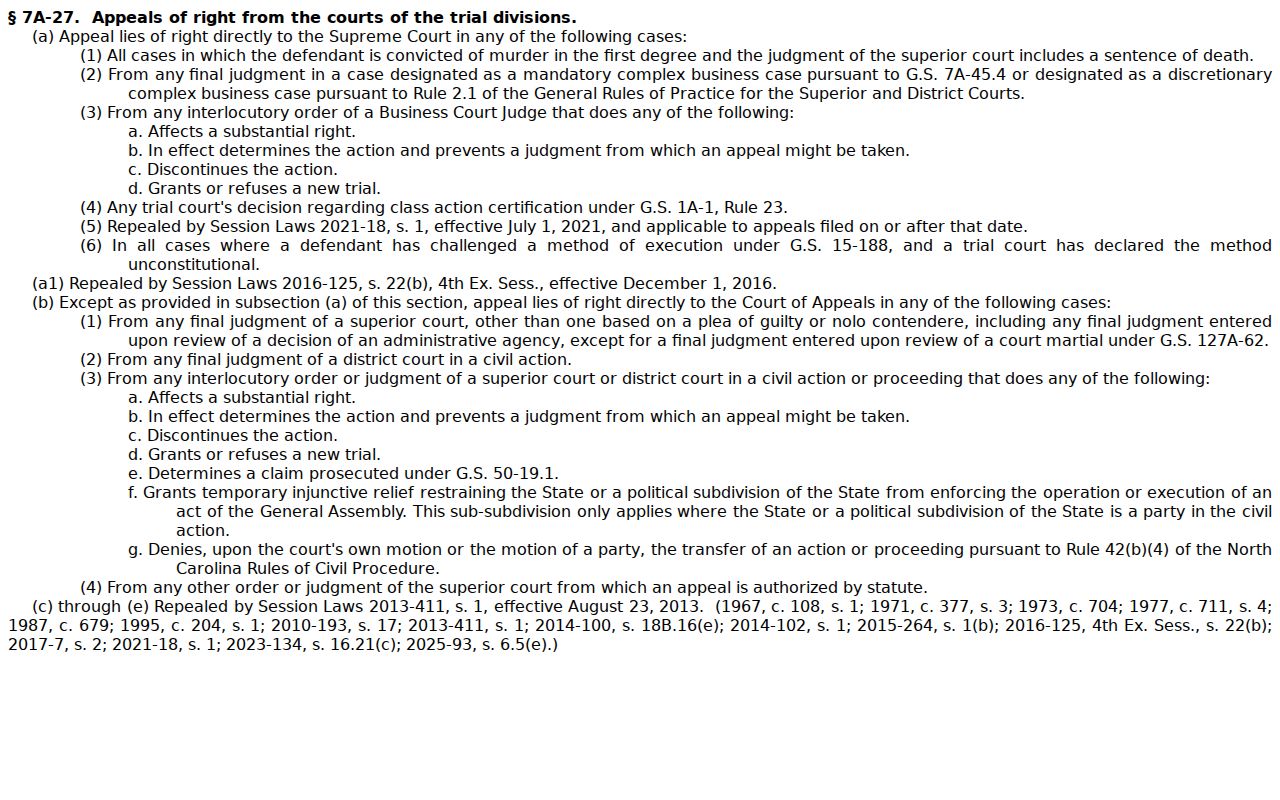
Use the local Case Summary for public trial-court activity. Then confirm any appeal through the appropriate court record and clerk channel.
Chowan Criminal Docket Access Limits
Some Chowan criminal docket material stays restricted. That holds even when a related Chowan case appears in Portal. The counsel-only access form, the clerk’s role, and the state access statutes all point one way. Public search does not override confidentiality. So ask the Chowan clerk about lawful access. Do not treat an unavailable document as a technical problem to solve. The Judicial Branch counsel-only access form shows the gap between public search and controlled access.
For ordinary public research, use Portal, a public terminal, or the Chowan clerk office. Those channels stay distinct from elevated counsel access.